
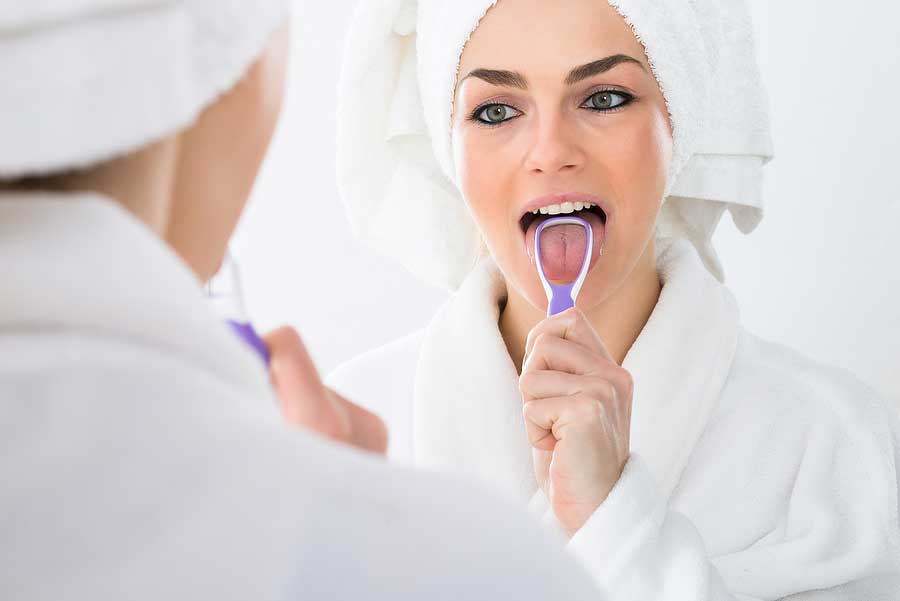
Your tongue does a lot of heavy lifting. It helps you taste your morning coffee, form words & swallow food, but its textured surface is also home to bacteria, food particles & cells that can contribute to tongue coating & unpleasant breath. Yet, while most of us diligently brush our teeth, the tongue is often overlooked in the oral routine.
Bacterial Hideout
Your tongue has a naturally rough surface covered with tiny structures called papillae. Those grooves & bumps are useful for taste & sensation, but they can also provide places for microorganisms & debris to accumulate. Oftentimes, the collected food debris & bacteria form a whitish or yellowish film that coats the tongue’s surface.
Mechanical cleaning physically disrupts & removes some of that buildup. Clinical research has found significant reductions in tongue-coating measurements after mechanical cleaning. Your mouth can feel noticeably cleaner after brushing your tongue because you are physically removing material from the tongue’s surface.
Culprit for Bad Breath
If bad breath has ever survived teeth brushing, your tongue may deserve some attention.
A significant contributor to ordinary oral bad breath is a group of chemicals called volatile sulfur compounds. Bacteria living in tongue coating can produce these compounds as they break down organic material. Research has found that cleaning the tongue can reduce both tongue coating & measurements associated with oral malodor.
More recent research continues to support the connection. A randomized controlled trial published in 2026 found that four weeks of tongue brushing reduced tongue-coating & volatile sulfur compound levels, with participants also reporting improvements in bad breath.
Brushing Beats Holding a Mint
Mints & cosmetic mouthwashes can make your breath smell temporarily fresher, but covering an odor is not quite the same as removing its source. The American Dental Association notes that cosmetic mouthrinses can temporarily mask bad breath without affecting the bacteria or volatile sulfur compounds responsible for it.
Tongue cleaning takes a different approach: instead of just adding a minty scent to the situation, it physically removes material from the tongue’s surface.
How to Brush
After brushing your teeth, use your toothbrush or dedicated tongue scraper to gently brush the tongue’s surface, working from farther back toward the front. Apply light pressure. Your tongue is living tissue, & vigorous scrubbing does not make the cleaning more effective & may even cause irritation. Pay particular attention to the back portion, where tongue coating & odor-producing bacteria tend to accumulate.
However, if brushing the back of your tongue triggers your gag reflex, start farther forward & gradually work back as you become accustomed to the sensation. It is also okay if you do not reach the absolute back of your throat.
Brushing your tongue is a tiny, easily implemented habit that reduces the bacterial load on your tongue’s surface & helps to combat at least one important source of bad breath. It is inexpensive, quick & easy to fold into the toothbrushing routine you are already doing.
Sources
https://www.nidcr.nih.gov/health-info/oral-hygiene
https://pubmed.ncbi.nlm.nih.gov/35010368/
https://pubmed.ncbi.nlm.nih.gov/41604763/
https://newsroom.clevelandclinic.org/2026/06/16/do-you-need-to-brush-your-tongue